What treatments help with leaking when you laugh?
Medically reviewed by Dr Martin Galy, Co-Founder & Director of Wellness & Longevity · Published 6 November 2026 · Last reviewed 6 November 2026
Quick answer: Leaking when you laugh, cough or sneeze is called stress urinary incontinence, and several treatments help. NICE recommends supervised pelvic floor muscle training for at least three months as the first step, alongside simple lifestyle changes. If leaks continue, options include devices, newer energy-based treatments and, for persistent cases, procedures in NHS specialist care.
Questions about your own situation? Message our team on WhatsApp: London · Dubai
Why do you leak when you laugh?
The NHS describes stress incontinence as urine leaking when the bladder is under pressure, usually because the pelvic floor muscles are weakened or damaged [2]. Pregnancy and vaginal birth, obesity, a family history and increasing age all raise the risk [2].
The NHS is clear that incontinence is not an inevitable part of ageing [2]. So "pelvic floor problems are just part of getting older" is a myth: they become more common with age, but they can be treated.
What are the treatment options, and how strong is the evidence?
The options form a ladder, starting with the simplest and most established.
| Option | Who it is usually for | Strength of evidence |
|---|---|---|
| Lifestyle changes (weight, fluids, caffeine) | Everyone with leaks | Guideline advice (NICE) [1] |
| Supervised pelvic floor muscle training | First-line for stress and mixed leaks | Strong: Cochrane review of 31 trials [5] |
| Bladder training | Urgency or mixed leaks | Guideline first-line for urgency and mixed leaks [1] |
| Vaginal or urethral devices | Occasional use, such as during exercise | Not for routine use (NICE) [1] |
| HIFEM chair (EMSELLA) | Some people alongside first-line care | Emerging: small studies, low certainty [6] |
| Local hormone treatments | Menopause-related vaginal and urinary symptoms | Guideline-supported for menopause symptoms; not a stand-alone treatment for stress leaks [1] |
| Bulking agents and surgery | Persistent leaks after first-line care | Specialist NHS care; effectiveness varies by procedure [1][4] |
Does lifestyle make a difference?
Lifestyle changes sit alongside every other treatment. NICE advises women with a BMI over 30 to lose weight, and suggests adjusting fluid intake if it is very high or very low [1]. The NHS also suggests cutting down on caffeine and alcohol [2].
Do pelvic floor exercises really work?
Pelvic floor exercises work for many women, and they are the first-line treatment. NICE recommends a supervised programme lasting at least three months, with at least eight contractions three times a day [1]. A specialist should first check that you can contract the muscles correctly [3].
A 2018 Cochrane review of 31 randomised trials (1,817 women) found that, in the trials measuring it, 74% of women with stress incontinence who trained reported improvement or cure, compared with 11% of women without treatment [5]. Most trials followed women for under a year, so long-term results are less certain [5].
"Supervised" matters: a pelvic health physiotherapist can correct technique. If you cannot contract the muscles at all, NICE says electrical stimulation or biofeedback can be considered [1].
What if you also need to rush to the toilet?
If you also get sudden, strong urges, you may have mixed incontinence. Bladder training, which teaches you to wait longer between feeling the urge and going, is first-line for urgency and mixed leaks. NICE recommends it for at least six weeks [1], and the NHS notes it can be combined with pelvic floor training [3].
Can devices or pessaries help?
NICE advises against using vaginal or urethral devices for routine management of incontinence, although they may be used occasionally to prevent leaks, for example during exercise [1]. NICE recommends considering vaginal pessaries for symptoms of pelvic organ prolapse, a different condition that can occur alongside leaks [1].
Where does the EMSELLA chair fit?
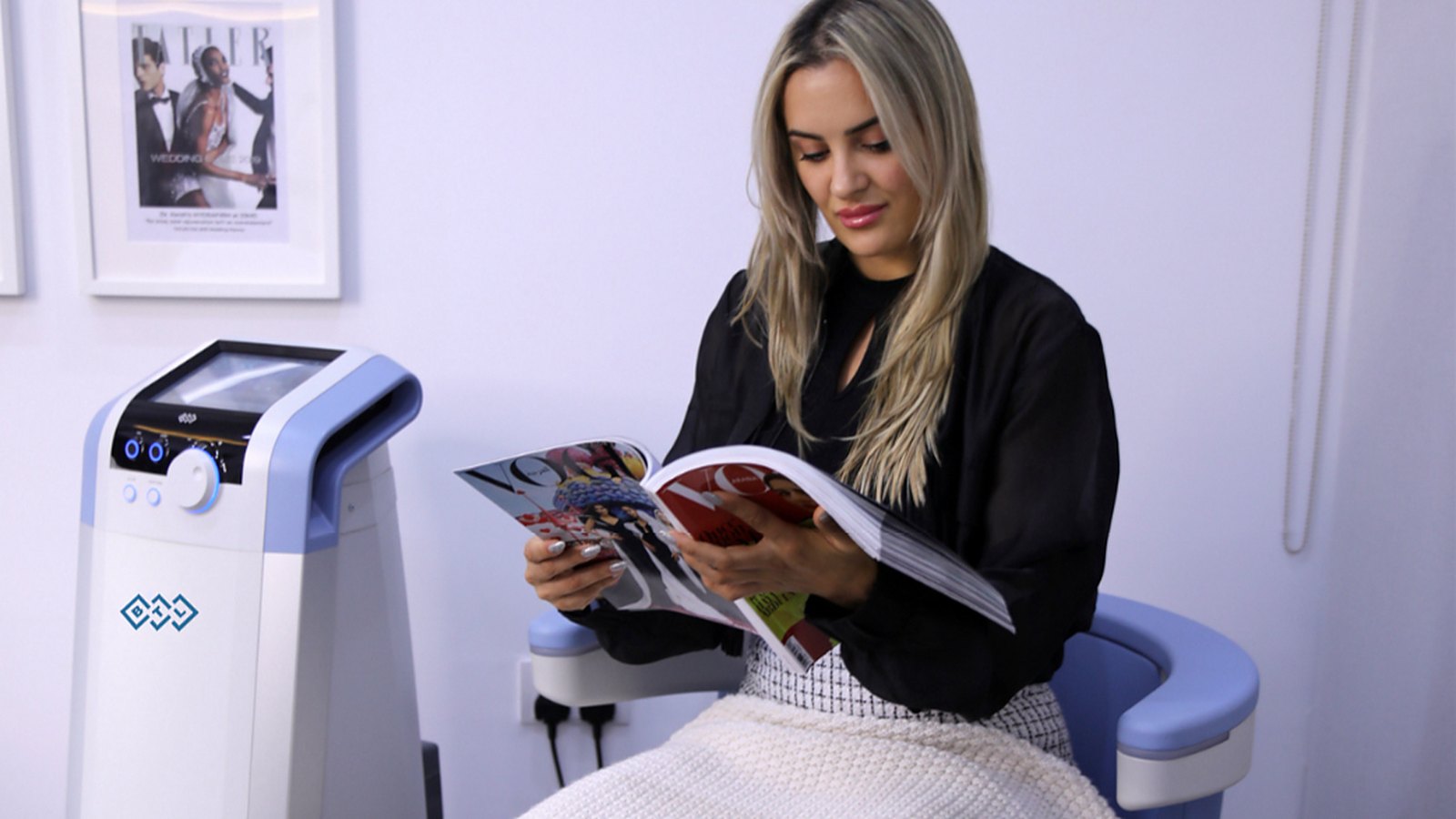
EMSELLA is a chair that uses high-intensity focused electromagnetic energy (HIFEM) to make the pelvic floor muscles contract while you sit fully clothed. 23MD offers it in London and Dubai as an option alongside first-line care, not instead of it.
The evidence is emerging. A 2025 systematic review of chair-based magnetic stimulation found five suitable studies, about 219 women in total [6]. Leakage scores improved, but the reviewers rated the certainty of the continence evidence as low, citing small samples, mixed designs, little follow-up beyond 6 to 12 months and studies using commercial devices [6]. NICE's continence guideline makes no recommendation on magnetic stimulation [1].
Can menopause make leaking worse?
Menopause can bring vaginal and urinary changes (genitourinary symptoms) that sometimes sit alongside leaks. NICE suggests considering local hormone treatment for these symptoms, but advises against systemic hormone therapy to treat incontinence itself [1]. Local hormone treatments are discussed with a doctor, and our women's hormone consultations look at them in the context of your wider health.
When are bulking agents or surgery used?
Procedures are for leaks that persist after first-line care, through NHS specialist services. The NHS describes colposuspension as an effective long-term treatment, and notes that slings made from your own tissue are often used because more is known about their long-term safety [4]. Bulking agents, injected into the wall of the urethra, are generally less effective than other procedures and may need repeating [1][4].
Do men get leaking when they laugh?
Men can get stress incontinence too, for example after prostate surgery. NHS continence services also list long-term coughing, excess weight and constipation as causes, and use pelvic floor exercises to treat both stress and urge leaks in men [7]. For persistent leaks, an artificial urinary sphincter is a specialist option [4]. Read more about men's health at 23MD.
When should you see a GP?
See a GP about any type of urinary incontinence [2]. Get checked promptly if you see blood in your urine, even a small amount or if you are unsure [8]. NICE also lists ongoing bladder or urethral pain, difficulty emptying your bladder, bowel leakage and previous pelvic surgery, cancer or radiotherapy as reasons to consider specialist referral [1].
The 23MD view
Leaking when you laugh is common and treatable. We always start with the basics: supervised pelvic floor training and simple lifestyle steps, with a GP or specialist assessment where anything suggests a different cause. For some patients, often around menopause, the conversation is part of a wider look at hormones and wellbeing. EMSELLA is an additional option we discuss honestly for suitable patients, including how much the evidence does and does not yet show.
Who this is for, and who it isn't for
- For: women and men who leak when they laugh, cough, sneeze or exercise, including after childbirth, around menopause or after prostate surgery.
- Not for: anyone with blood in their urine, ongoing pain or difficulty emptying the bladder. Please see a GP first.
Frequently asked questions
How long do pelvic floor exercises take to work?
NICE recommends at least three months of supervised training before judging whether it has helped, and continuing if it does [1].
Is leaking after having a baby normal?
It is common, as pregnancy and vaginal birth can weaken the pelvic floor [2], but it is treatable. Raise it with your GP or midwife.
Is there a medicine for stress incontinence?
The NHS says a medicine may be considered if surgery is unsuitable or not wanted [3]. It is a prescription medicine discussed with a doctor.
Does the EMSELLA chair replace pelvic floor exercises?
No. The evidence is small and low certainty, and it is not a replacement for supervised training [6].
Talk to a 23MD doctor
If leaks are affecting your daily life, you are welcome to talk it through with one of our doctors; see how we approach urinary leakage and pelvic floor weakness within women's health. Suitability and results vary, and your doctor will discuss the benefits and risks of each option.
- London: Message our London team on WhatsApp · 23 Elystan Street, Chelsea, London SW3 3NT
- Dubai: Message our Dubai team on WhatsApp · The Court Residence, 39B Street, Jumeirah 1
23MD is a doctor-led clinic in Chelsea, London (since 2015) and Jumeirah 1, Dubai (since 2023).
References
- National Institute for Health and Care Excellence. Urinary incontinence and pelvic organ prolapse in women: management (NG123). NICE, 2019.
- NHS. Urinary incontinence. NHS website, last reviewed 15 June 2023.
- NHS. Urinary incontinence: non-surgical treatments. NHS website, last reviewed 15 June 2023.
- NHS. Urinary incontinence: surgery and procedures. NHS website, last reviewed 15 June 2023.
- Dumoulin C, Cacciari LP, Hay-Smith EJC. Pelvic floor muscle training versus no treatment, or inactive control treatments, for urinary incontinence in women. Cochrane Database of Systematic Reviews, 2018; summarised by NIHR Evidence.
- Sacarin G, et al. Chair-based magnetic pelvic floor stimulation and female sexual function in women with urinary incontinence: a systematic review. Journal of Clinical Medicine, 2025;14(23):8496.
- Berkshire Healthcare NHS Foundation Trust Continence Service. Pelvic floor exercises for men.
- NHS. Blood in urine. NHS website.