What skin tightening treatments are available?
Medically reviewed by Dr Suha Kersh, Co-Founder & Lead Aesthetic Doctor · Published 29 October 2026 · Last reviewed 29 October 2026
Quick answer: Non-surgical skin tightening treatments use controlled heat, from radiofrequency or focused ultrasound, to prompt the skin to make new collagen. The main options are radiofrequency, micro-focused ultrasound (Ultherapy), RF microneedling and EMFACE. Studies show modest, gradual improvement for mild to moderate laxity. Marked sagging usually responds better to surgery.
Questions about your own situation? Message our team on WhatsApp: London · Dubai
How do non-surgical skin tightening treatments work?
Non-surgical skin tightening works by heating the dermis, the deeper layer of skin that holds collagen and elastin, without cutting or removing the surface. The heat is thought to cause existing collagen to contract and to trigger a slower healing response in which new collagen is laid down over weeks to months [1]. That is why results build gradually rather than appearing straight away.
A 2015 review of 31 radiofrequency studies in Anais Brasileiros de Dermatologia is a useful reality check: almost all reported a benefit, but nearly all lacked a control group, none were blinded, and ideal settings are not established [1]. Small, often industry-linked studies are typical of this field.
What is radiofrequency skin tightening (Exilis and HydraFirm)?
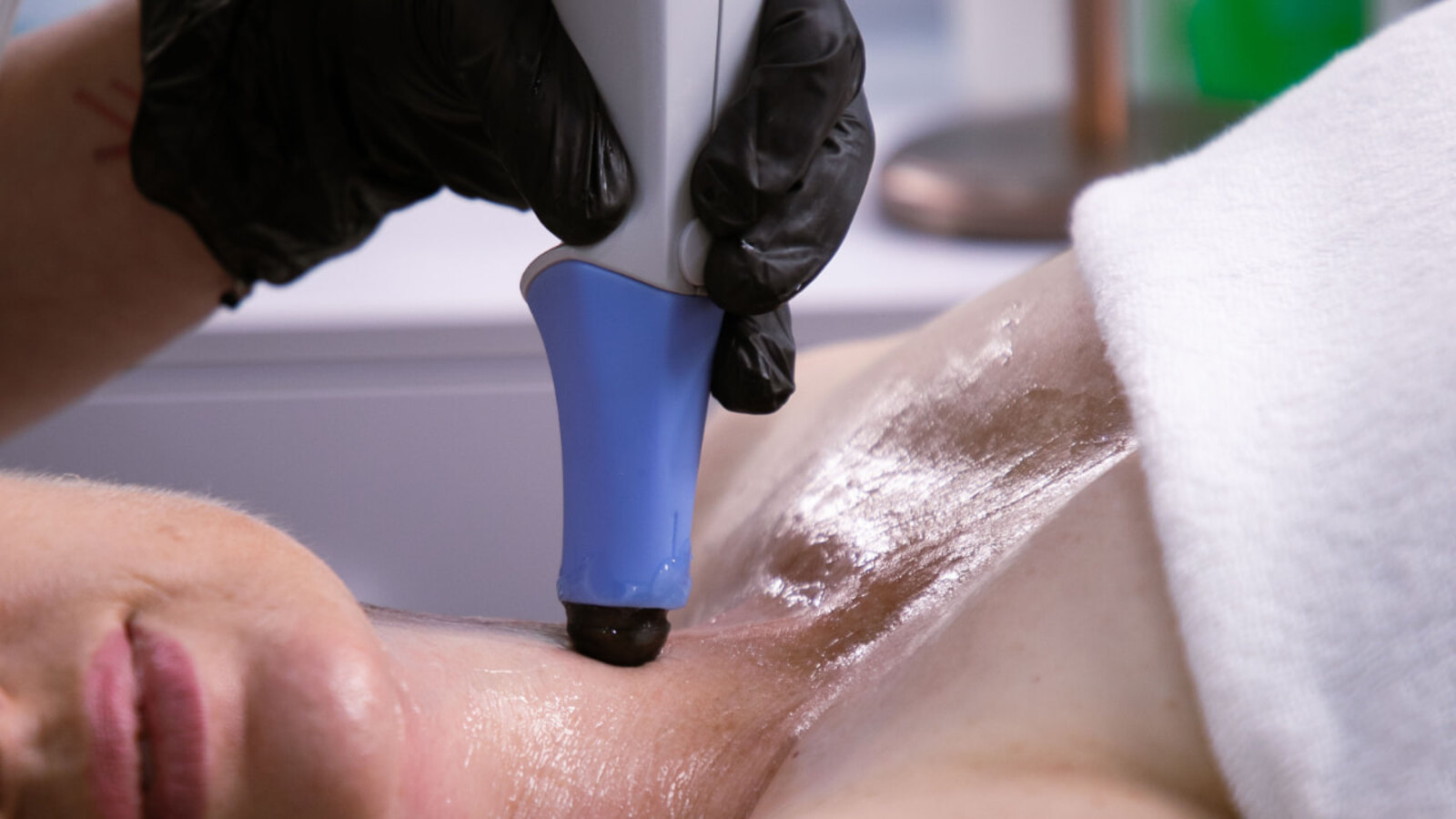
Radiofrequency (RF) passes a controlled electrical current through the skin, which turns it into gentle heat. Exilis combines monopolar RF, which reaches deeper tissue, with ultrasound to warm the skin evenly.
In a 2014 study in the Journal of Drugs in Dermatology, 24 women had monopolar RF on the mid and lower face; 92% showed at least mild improvement in laxity at three months [2]. The device was not named, there was no control group, and the numbers are small.
HydraFirm is 23MD's signature treatment, created by Dr Kersh: a hydrating facial followed by Exilis radiofrequency in one appointment. The facial works on the surface; a review in Clinical, Cosmetic and Investigational Dermatology cites one small study with fewer fine lines after six hydradermabrasion sessions [3]. The RF works deeper. HydraFirm is a course of four, then a top-up every three months. There are no trials of HydraFirm itself; the evidence is for its components.
How does Ultherapy (micro-focused ultrasound) compare?
Ultherapy uses micro-focused ultrasound to create tiny points of heat at set depths, including the supporting layer tightened in a facelift. It is usually one session.
A 2023 systematic review of 16 studies found that 92% of patients improved on doctors' ratings at three months, while patients' own ratings were more modest: about half reported mild improvement at one year [4]. Measured brow lifts were small, roughly 0.5 to 1.7 mm. Treatment was moderately painful, short-lived redness was common, and people with more laxity or a BMI over 30 responded less well [4]. The studies were small and mostly in women. At 23MD, Ultherapy is offered in London.
What is RF microneedling?
RF microneedling uses fine insulated needles to deliver radiofrequency energy at a precise depth below the surface. 23MD uses the Secret RF device; it is offered in Dubai. A typical course is three to four sessions four to six weeks apart, with about 24 to 72 hours of redness and swelling. See our RF microneedling page.
A 2021 critical review in Dermatologic Surgery, limited to randomised, split-face or blinded studies, concluded that RF microneedling is effective and can be repeated safely, with collagen remodelling continuing up to six months [5]. A 2026 scoping review in JMIR Dermatology adds perspective: one comparison found surgery improved laxity by 46% against 16% for RF microneedling, and the technique does not address jowls or fat under the jaw [6].
What are EMFACE and Exion?
EMFACE combines synchronised radiofrequency with HIFES, electrical stimulation that contracts the facial muscles beneath the skin. In a 2025 pilot study of 10 people, 7 of the 8 who completed it improved on a standard aesthetic scale at three months [7]. The manufacturer, BTL, sponsored the study, and there was no control group.
Exion, offered in London, combines monopolar radiofrequency with targeted ultrasound. A 2025 open-label study of 52 people treated with BTL's EMFACE and Exion applicators reported more collagen and elastin on biopsy at three months, but only five people were biopsied and there was no control group [8].
Skin tightening treatments compared
| Option | How it works | Typical course at 23MD | Downtime | Evidence strength |
|---|---|---|---|---|
| Radiofrequency (Exilis) | Monopolar RF plus ultrasound heats the dermis | 4–6 weekly sessions | None expected | Low: small uncontrolled studies [1][2] |
| HydraFirm | Hydrating facial, then Exilis RF | Course of 4, top-up every 3 months | None expected | No trials of HydraFirm; components only [2][3] |
| Ultherapy (London) | Micro-focused ultrasound heats set depths | Usually 1 session | Redness, short-lived | Moderate: systematic review of small studies [4] |
| RF microneedling (Secret RF, Dubai) | Needles deliver RF below the surface | 3–4 sessions, 4–6 weeks apart | About 24–72 hours | Moderate: reviews of controlled studies [5][6] |
| EMFACE | RF plus muscle stimulation | 4 sessions over 4 weeks | None expected | Low: small, manufacturer-funded [7] |
| Exion (London) | Monopolar RF plus targeted ultrasound | 4–6 weekly sessions | None expected | Low: one small open-label study [8] |
Courses are 23MD's usual protocols and vary by person. See all energy-based treatments.
Whichever option you choose, daily skincare supports it. At 23MD that includes 23MD Skin Medicine, five face creams matched to your skin and selected by a doctor after consultation.
When is surgery the more honest answer?
Surgery is usually the more honest answer for heavy jowls, marked looseness along the jaw and neck, or excess skin. Non-surgical treatments achieve a fraction of a facelift's change [6], and cannot remove skin.
23MD London does not offer surgery. In Dubai, surgical options are by referral to Dr Frederik Koelle, our surgical partner, with consultations at our Jumeirah 1 clinic.
The 23MD view
"Skin tightening is rarely one machine. I look at skin quality, muscle, volume and bone together, the thinking behind Treatment Stacking. For early softening, a gradual approach such as HydraFirm, which I created after trying it on my own skin, often makes sense. Where laxity is more advanced, I would rather talk honestly about surgery than suggest a course that won't meet expectations. Every plan starts with a consultation." — Dr Suha Kersh
Who this is for, and who it isn't for
- May suit: mild to moderate laxity on the face, jawline or neck, with a preference for gradual change, or maintaining results alongside other treatments.
- Less likely to suit: marked sagging or excess skin, where surgery is usually more effective [6]; responses may be weaker with a BMI over 30 [4].
- Needs a doctor's assessment first: pregnancy or breastfeeding, active skin infection, metal or electronic implants in the area, or recent isotretinoin use.
Frequently asked questions
Does non-surgical skin tightening really work? Non-surgical skin tightening can produce modest, gradual improvement for mild to moderate laxity, but most studies are small and many are funded by device makers [1][4][7]. It does not match surgery [6].
How long do skin tightening results last? In the Ultherapy review, improvement was still reported at one year, but longer-term data are lacking [4]. Skin keeps ageing, so maintenance sessions are common.
Does skin tightening hurt? Most people feel warmth. In studies, Ultherapy averaged about 4 out of 10 for pain [4] and EMFACE about 3 [7].
Can skin tightening treatments be combined? Treatments working at different depths are often combined, but there is little research on specific combinations. Your doctor will advise on order and spacing.
Not sure which option might suit your skin? Explore your concerns with our Skin Expert, which offers general information based on Dr Kersh's approach. It does not diagnose and does not replace an assessment by a doctor.
Talk to a 23MD doctor
If you would like to understand which options might suit you, including whether surgery is worth discussing, our doctors are happy to talk it through in a 45 to 60 minute consultation. Suitability and results vary; your doctor will explain benefits and risks.
- London: Message our London team on WhatsApp (+44 7714 307850) · 23 Elystan Street, Chelsea
- Dubai: Message our Dubai team on WhatsApp (+971 50 876 2323) · The Court Residence, 39B Street, Jumeirah 1
23MD is a doctor-led clinic in Chelsea, London (since 2015) and Jumeirah 1, Dubai (since 2023).
References
- Araújo AR, Soares VPC, Silva FS, Moreira TS. Radiofrequency for the treatment of skin laxity: mith or truth. Anais Brasileiros de Dermatologia. 2015;90(5):707–21. https://www.scielo.br/j/abd/a/H44b5rY7LC4dPBNY9cjP3hd/?lang=en
- McDaniel D, Weiss R, Weiss M, Mazur C, Griffin C. Two-treatment protocol for skin laxity using 90-watt dynamic monopolar radiofrequency device with real-time impedance intelligence monitoring. Journal of Drugs in Dermatology. 2014;13(9):1112–7. https://jddonline.com/articles/two-treatment-protocol-for-skin-laxity-using-90-watt-dynamic-monopolar-radiofrequency-device-with-re-S1545961614P1112X
- Loesch MM, Somani AK, Kingsley MM, Travers JB, Spandau DF. Skin resurfacing procedures: new and emerging options. Clinical, Cosmetic and Investigational Dermatology. 2014;7:231–41. https://www.dovepress.com/skin-resurfacing-procedures-new-and-emerging-options-peer-reviewed-fulltext-article-CCID
- Contini M, Hollander MHJ, Vissink A, Schepers RH, Jansma J, Schortinghuis J. A systematic review of the efficacy of microfocused ultrasound for facial skin tightening. International Journal of Environmental Research and Public Health. 2023;20(2):1522. https://pmc.ncbi.nlm.nih.gov/articles/PMC9861614/
- Tan MG, Jo CE, Chapas A, Khetarpal S, Dover JS. Radiofrequency microneedling: a comprehensive and critical review. Dermatologic Surgery. 2021;47(6):755–61. https://scholars.mssm.edu/en/publications/radiofrequency-microneedling-a-comprehensive-and-critical-review-2/
- Panlilio M, Bolen R, Martini O, Bonk A, Tedesco J. Navigating the intersection of radiofrequency microneedling and surgical facelifts: scoping review. JMIR Dermatology. 2026;9:e78385. https://derma.jmir.org/2026/1/e78385
- Halaas Y. The simultaneous application of synchronized radiofrequency and HIFES technology improves the tone of facial muscles, as assessed by ultrasound echo intensity: a pilot study. Aesthetic Surgery Journal Open Forum. 2025;7:ojaf028. https://academic.oup.com/asjopenforum/article/8123043
- Chilukuri S, Kent DE. Efficacy of multimodal facial rejuvenation techniques. Medical Research Archives. 2025;13(7). https://esmed.org/efficacy-of-multimodal-facial-rejuvenation-techniques/