Turkey neck after weight loss: what works and what doesn't
Medically reviewed by Dr Suha Kersh, Co-Founder & Lead Aesthetic Doctor · Published 23 November 2026 · Last reviewed 23 November 2026
Quick answer: Loose neck skin after weight loss is common, because the skin that stretched over fat doesn't always shrink back. Mild to moderate looseness can improve modestly with skin-tightening treatments such as radiofrequency or microfocused ultrasound, given over several months. These treatments tighten; they don't remove skin. When the skin hangs in folds, a surgical neck lift is usually the only treatment that gives a clear result. A doctor can tell you which group you are in.
Worried about your neck? Message our team on WhatsApp: London · Dubai
What is turkey neck, and why does it appear after weight loss?
"Turkey neck" is the everyday name for loose, crepey or hanging skin under the chin and down the front of the neck, sometimes with vertical bands. It appears gradually and naturally with age, especially in women who are not taking hormone treatments, and also after weight loss. This is because the neck loses fat that was holding the skin out, and the skin may not contract enough to follow. So it begins to sag. Age, sun damage and how quickly the weight came off all affect how well skin recovers during and after weight loss.
In a small study of women who had a facelift after losing more than 100 pounds, independent reviewers judged them to look about five years older than their real age before surgery [1]. The authors suggest that major weight loss may speed up visible ageing of the face and neck [1].
Four things can contribute, and they need different treatments:
- Loose skin: skin that has lost firmness and stretch.
- Neck bands: the thin neck muscle (platysma) showing as vertical cords.
- Dry, crepey skin: poor skin quality can worsen the appearance of turkey neck.
- Remaining fat under the chin: sometimes still present after weight loss.
Should you wait until your weight is stable?
Usually, yes. An international panel of aesthetic doctors advised in 2026 that treatment should be planned around the whole weight-loss journey, because the face keeps changing while weight is falling [2]. Treating the neck while you are still losing weight may mean the result needs revisiting. Skin-quality work can often start earlier; tightening and surgery are best planned once weight has settled.
What non-surgical treatments can help turkey neck?
Each of the four causes needs its own treatment, so most turkey necks need a combination or Treatment Stack. Non-surgical treatment can firm, smooth and reshape the neck; it cannot remove excess skin. Excess skin generally requires surgery.
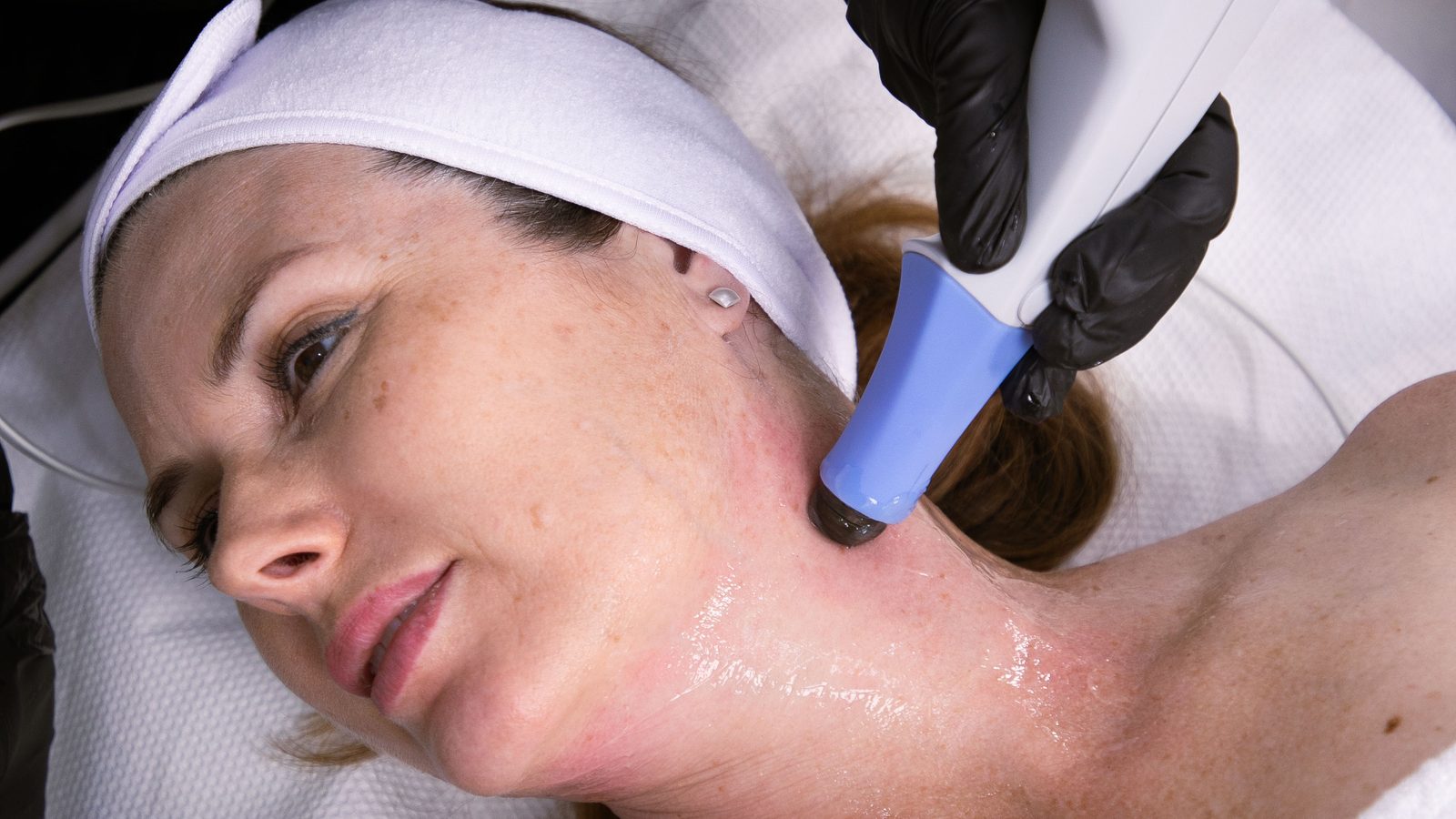
- Loose skin: tighten it. Loose skin responds to tightening with focused ultrasound (HIFU) such as Ultherapy (London), radiofrequency such as Exilis (London and Dubai), or radiofrequency microneedling (London and Dubai). Muscle-toning treatment such as Emface can support the result. In a study of 64 adults with lower face and neck laxity, doctors and patients reported improvement at two, three and six months after microfocused ultrasound, though the benefit may be limited to some patients [3]. Evidence for radiofrequency microneedling on the neck is still limited to small studies [4].
- Neck bands: relax them. Prominent platysmal bands, which often come with jowling, respond well to lines and wrinkles treatment, assessed individually. Neck exercises are not the answer: they can strengthen the bands so they stand out more.
- Dry, crepey skin: improve its quality. Skin boosters, such as polynucleotides (PDRN) or hyaluronic acid, combined with radiofrequency such as Exilis, can improve dry, crepey neck skin. Filler is rarely the answer for a loose neck; see filler after weight loss.
- Fat under the chin: reshape it. Emface Submentum (London and Dubai) combines radiofrequency with muscle stimulation and is designed for mild fullness under the chin. A doctor will first check whether fat or loose skin is the main problem, because the treatment is different.
A systematic review of microfocused ultrasound found that results are best in mild to moderate laxity and fall as laxity increases [5]. This is the honest limit of every energy treatment: the looser the skin, the smaller the change. Results build over two to six months, and treatments may need repeating.
You can read how these devices compare in our article on skin-tightening treatments.
When is a neck lift the right answer?
A neck lift is usually the right answer when skin hangs in folds or a deep wattle has formed, because surgery is the only treatment that removes excess skin and tightens the muscle beneath. In the study of patients after major weight loss, facelift surgery reduced how old they looked by about six years [1]. Surgery has a longer recovery and real risks, which a surgeon will discuss with you. Consultations with Dr Frederik Koelle, Plastic Surgeon, 23MD Dubai, take place at 23MD Dubai, and surgery takes place at our partner hospital in Dubai. He is co-founder and chief physician in plastic surgery at Caolín in Copenhagen. Preparation and aftercare take place at 23MD (read more about our Caolín partnership). London patients can book a consultation at 23MD Dubai. See face surgery.
Results vary from person to person, and a doctor will discuss the benefits and risks of any treatment with you.
The 23MD view
The first question with a loose neck is honest: is this something we can tighten, or something that needs surgery? If the skin still has some spring, a measured course of tightening, such as focused ultrasound (HIFU) and radiofrequency, often with skin-quality treatment like polynucleotides (PDRN) or skin boosters, can make a real difference over a few months. Tight platysmal bands that pull the neck and jawline down can be relaxed with lines and wrinkles treatment. If, however, the skin is very loose and hangs, I would rather tell someone that surgery is the better route than sell treatments that can't deliver the outcome they expect. This is how I apply Treatment Stacking: the right treatment, in the right order, for the right patient.
Who this is for, and who it isn't for
This may be useful if:
- you have lost weight and your neck or under-chin skin has become loose;
- you want to know whether non-surgical treatment is realistic for you.
This isn't for you if:
- you have a new lump or swelling in your neck. See your GP;
- worries about food, weight or your appearance are affecting your daily life. Talk to your GP or a qualified professional.
Frequently asked questions
What causes turkey neck?
At 23MD clinics, the two main causes we see most often are age and rapid weight loss. In Dr Kersh's experience, age-related turkey neck often responds better to treatment once hormones have been assessed and, where appropriate, optimised.
Do neck exercises or creams help turkey neck?
Not much, and exercises may make it look worse. Once the skin has become loose, the platysmal bands show more, and exercises can tighten and strengthen those bands so they stand out further.
What is the best treatment for turkey neck?
Usually a combination, because turkey neck has several parts. Loose skin needs tightening, and responds well to focused ultrasound (HIFU) such as Ultherapy, with muscle-toning treatment such as Emface. Prominent platysmal bands, which often come with jowling, respond well to lines and wrinkles treatment. Dry, crepey skin improves with skin boosters, such as polynucleotides (PDRN) or hyaluronic acid, combined with radiofrequency such as Exilis. Results develop over two to six months [3].
Does losing weight make turkey neck worse?
Rapid weight loss can exaggerate turkey neck, especially when jowling develops too. You can start on skin quality while you are still losing weight, but tightening and surgery are best planned once your weight is stable [2].
When do you need surgery for turkey neck?
Turkey neck in people under 40 is generally easier to treat without surgery than advanced, age-related turkey neck. When the skin hangs in folds, a surgical opinion is usually the honest answer [1, 5]. Consultations for neck lift surgery with Dr Frederik Koelle of Caolín take place at 23MD Dubai, and surgery takes place at our partner hospital in Dubai. London patients can book a consultation at 23MD Dubai.
Planning treatment around your weight loss? Use our Treatment Stacker to set out your goal and timeline and draft a sequenced plan for a 23MD doctor to review. It gives general information, not a diagnosis, and doesn't replace a consultation.
Talk to a 23MD doctor
If your neck has changed after weight loss, speak to our team. Your consultation is with a doctor, who will assess your neck and face together and tell you honestly what will and won't help.
- London23 Elystan Street, Chelsea, London SW3 3NTMessage our London team on WhatsApp
- DubaiThe Court Residence, 39B Street, Jumeirah 1, DubaiMessage our Dubai team on WhatsApp
23MD is a doctor-led clinic in Chelsea, London (since 2015) and Jumeirah 1, Dubai (since 2023).
References
- Couto RA, Waltzman JT, Tadisina KK, et al. Objective assessment of facial rejuvenation after massive weight loss. Aesthetic Plastic Surgery. 2015;39(6).
- Nikolis A, Somenek MT, Dayan S, et al. Managing aesthetic needs in prescription medication-driven rapid weight loss patients: results of an international consensus. Journal of Cosmetic Dermatology. 2026;25(1):e70644.
- Baumann L, Zelickson B. Evaluation of micro-focused ultrasound for lifting and tightening neck laxity. Journal of Drugs in Dermatology. 2016;15(5):607–614.
- Demesh D, Cristel RT, Gandhi ND, Kola E, Dayan SH. The use of radiofrequency-assisted lipolysis with radiofrequency microneedling in premature jowl and neck laxity following facialplasty. Journal of Cosmetic Dermatology. 2021;20(1):93–98.
- Contini M, Hollander MHJ, Vissink A, Schepers RH, Jansma J, Schortinghuis J. A systematic review of the efficacy of microfocused ultrasound for facial skin tightening. International Journal of Environmental Research and Public Health. 2023;20(2):1522.